Zeus vs Hades — review
Dual mechanic: Zeus (+) and Hades (×)
Every spin, either god can throw multiplier orbs onto the grid — and the two work in fundamentally different ways. Zeus's gold orbs carry a plus value from +2x at the low end up to +250x for a single rare orb. Hades's violet orbs carry a times value from ×2 up to ×10. When a tumble cluster resolves, every orb currently on the grid is applied in order: Zeus orbs are summed first, then Hades orbs multiply the summed total.
A concrete example: land two Zeus orbs (+15x and +40x) plus one Hades orb (×5) on a spin that pays a base 10x cluster. The maths runs 10 + 15 + 40 = 65x, then × 5 = 325x your bet. On a £0.20 spin that is £65 from a single tumble. Chain two more tumbles in the same round with fresh orbs and the numbers snowball fast — this stacking is why the game reaches its 5,000x ceiling more often than Gates of Olympus reaches its own cap.
Base-game orb frequency is deliberately dry: expect around 1 orb every 8-10 spins, with meaningful combinations of Zeus+Hades landing roughly once every 40 spins. This is where the volatility rating earns its stripes.
Free spins
Four or more scatter symbols (Zeus or Hades busts, mixed) trigger the free-spins round with 15 free spins. The critical difference from the base game: multipliers accumulate across the entire round rather than resetting per spin. Every Zeus orb collected adds permanently to a persistent running total; every Hades orb multiplies that total on the spin it lands.
Retriggers land on any subsequent 3+ scatters inside the round and add 5 extra spins per retrigger. Because orbs appear roughly 3x more often inside the bonus than in base play, a long round has plenty of chances to compound. The trade-off is a high dead-round rate of around 30% — roughly three in every ten triggered bonuses will pay under 20x total, so temper expectations before pressing the wager button.
Peak rounds — the ones that touch the 3,000-5,000x range — almost always involve at least two Hades ×5 or better orbs landing whilst the Zeus running total is already above +100x. Those rounds are rare (empirically 1 in every 40-50 triggered bonuses) but they are what make the game worth playing.
Bonus Buy
The Bonus Buy button jumps straight into the 15-free-spin round for 100x your current bet. On the £0.20 minimum that is £20 per buy; on £1 spins it is £100. Pragmatic quotes an effective RTP of roughly 97.5% in Buy mode versus 96.50% in base play, so the theoretical EV is slightly positive — but variance is brutal.
When Buy makes sense: you have a bankroll of at least 2,000x base bet (so 20+ buys of runway), you accept that 30% of your buys will pay back under 50% of their cost, and you are chasing the ceiling rather than session grind. When it does not: welcome-bonus wagering is active (Buy is disabled during rollover by Mr Punter's T&Cs), or you cannot stomach three consecutive dud buys — because it will happen.
Strategy
High volatility rewards patience and discipline over cleverness. Practical session rules:
- Minimum bankroll: 250x base bet for a base-game session (£50 at £0.20)
- Bankroll for Buy-only sessions: 2,000x base bet minimum
- Bet sizing: fixed for the session, do not chase losses by scaling up
- Ante-Bet: adds 25% to your stake to double scatter chance — mathematically neutral, but it front-loads variance
- Autoplay in blocks of 50 with a loss-stop at 40% of session budget
Short 100-spin sessions rarely produce meaningful returns because the bonus hits roughly 1 in 180 base spins. Long sessions of 500+ spins tend to converge toward the published RTP, but only if bet size stays disciplined throughout.
Zeus vs Hades vs Gates of Olympus — which to pick
Both games run Pragmatic's 6×5 pay-anywhere engine with the same tumble mechanic, so the surface feel is nearly identical. The maths diverges at the orb layer. Gates of Olympus uses a single class of multiplier orb (Zeus, additive up to 500x) and a 5,000x cap. Zeus vs Hades splits the orbs in two, keeps the same 5,000x cap, but the multiplicative Hades orbs mean rounds explode more aggressively when they hit — and fizzle harder when they do not.
Pick Gates of Olympus if your bankroll is small (£20-£50), you want steadier base-game feedback, and you prefer the safer additive maths. Pick Zeus vs Hades if you have a bigger buffer (£100+), you can weather deeper cold streaks, and you want the higher realistic ceiling on Bonus Buy rounds. Both are 100% contribution to the Mr Punter welcome bonus rollover, so either works for clearance — but Gates is the calmer clearance choice.
 MP
MP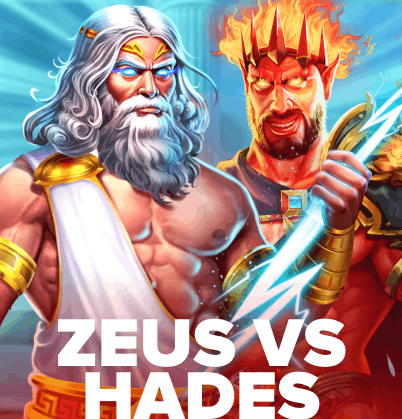 ⚡
⚡
 CANDY
CANDY CHICKEN
 BIGGER
 KOI
KOI GORILLA
 HOT
HOT